
Don’t wait until it’s broken.
Wellbeing is an operating cost, not a luxury.
SIID Labs (said /siːd/) was created in response to the growing pressure on mental health care in Australia and worldwide.
Sam Young is a counsellor and mental health professional who has watched the public system from the inside. People reach help at the point where they can no longer manage without it. By then the work is repair, and the limit sits in the arrangement rather than in the people inside it.
SIID Labs works at the other end of that sequence, before the damage rather than after it. Wellbeing hygiene is preventative, proactive, monitored and measured, delivered to individuals, teams and organisations through programs, workshops, coaching and consultancy.
Maintained deliberately, wellbeing does two things. It stops degrading, and the level a person or a team operates at rises.
Wellbeing hygiene
Wellbeing responds to consistent maintenance, in the same way dental health or physical fitness does. Most people, and most organisations, attend to it only once something has gone wrong. By that point repair takes longer, costs more, and is less certain of working.
Wellbeing hygiene is the practice of doing it the other way round. Maintaining wellbeing deliberately, at a cadence that fits the life someone actually has, and measuring whether the maintenance is working.
There is no universal definition of being well, and being instructed on how to be well is usually counterproductive. Wellbeing is what a person can carry with the capacity they have, which is why this work starts with capacity rather than with a prescribed routine.
Why preventative
Preventative wellbeing is moving from the margins toward the mainstream. Demand is rising, and so is the acknowledgement behind it, from clinicians, from governments, and from the organisations carrying the cost.
Prevention lowers the odds of needing help or care. It also prepares people for the times when trouble arrives anyway. The skills and the routines are already in place, so an individual, a team or an organisation comes through it faster and at lower cost.
The same argument runs in the other direction. Prevention is worth paying for when nothing is wrong at all, because a person working from full capacity produces better work than a person working from reserves, and recovers faster between demanding periods. For an organisation that shows up as output, not just as fewer absences. This is a performance case as much as a cost case.
The work is holistic, strengths-based and solution-focused, which leaves capability with the people who have to use it.
The way organisations account for the wellbeing of the people inside them is changing. SIID Labs works at the front of that change, treating wellbeing hygiene and maintenance as part of how individuals, teams and organisations sustain and improve themselves.
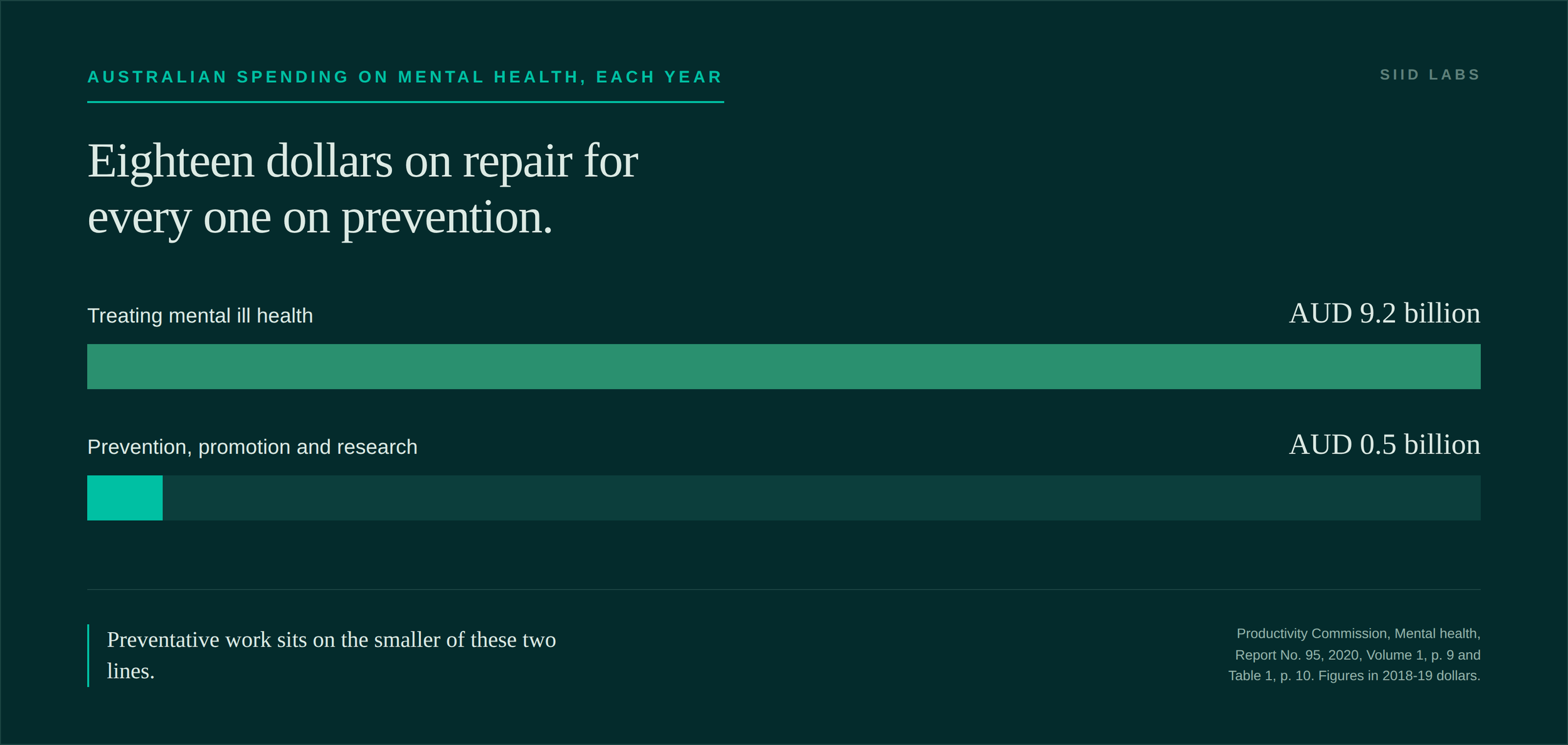
Underneath the shift is an economic argument. Australia spends about eighteen dollars treating mental ill health for every one dollar spent on prevention, promotion and research.
Sam Young
Sam Young is the founder of SIID Labs and a counsellor registered with PACFA. He works with individuals, teams and organisations across Australia and across industries.
After years of clinical practice in the public mental health system, Sam grew frustrated with what those systems are built to do. People qualify for care only once they are already in the red and in distress. Even then they meet convoluted referral processes, long waitlists, and little choice of practitioner or method.
The model is reactive, and it is organised around a person’s deficits, which can disempower the people asking for help. Repair on those terms costs more, takes longer and works less reliably than maintenance would have.
Sam understands the problem professionally and personally. Sustained demand in high performing roles, carried alongside everything a life holds outside them, is familiar to him as more than clinical material. That is part of what led him to create SIID Labs and the wellbeing hygiene approach.
The approach is multidisciplinary by design. Training and practice across psychology, counselling and psychotherapy, dramatic arts, yoga teaching and honours-level wellbeing research sit behind how clients are worked with: people at the top of their field, struggling in ways nobody around them has named.
Qualifications
Registered counsellor and psychotherapist, PACFA
Master of Counselling and Psychotherapy
Bachelor of Psychological Science with Honours
Bachelor of Dramatic Arts
Professional indemnity and public liability insurance held

Who this is for
Growth happens on stable ground. Wellbeing hygiene creates the ground, then works on what a person, a team or an organisation is capable of producing.
Founders and business owners who have created something and intend to keep running it
Executives and senior leaders who want to operate at a higher level than they are currently managing
Leadership teams whose capacity sets the pace for everyone below them
Organisations that treat wellbeing as an operating cost, and that want the people inside them growing as fast as the business is
People who already believe this and want to know what it costs
How the work is measured
Wellbeing is difficult to measure. No single number captures it, and the parts that matter most to a person are often the parts hardest to put a figure on. That is a reason to be careful about what gets measured, not a reason to skip it.
Measurement uses validated self-report instruments. The primary one is the Warwick-Edinburgh Mental Wellbeing Scale, used in research and public health, and licensed to SIID Labs. It is taken at the outset to establish a baseline, then at regular intervals, so change is visible rather than asserted and the maintenance can be adjusted to what the data shows.
Why it is measured
Wellbeing is defined broadly and held personally. What counts as well for one person, team or organisation is not what counts for the next, which is why the work starts by establishing what is being aimed at and how it will be recognised.
Measured over time, the data does more than record a score. It shows where the load concentrates: which points in a week, a month or a quarter cost the most, and where capacity is drawn down faster than it is replaced. Those points can then be planned for instead of absorbed.
Measurement is the part of this SIID Labs intends to keep developing. The more precisely wellbeing can be tracked for a particular person, team or organisation, the more specific the maintenance becomes.